The Effect of Night Study Patterns on Academic Performance among Medical Students at Bahri University, Khartoum State, Sudan, 2025.
Ziryab Mahmoud¹, Asgad Ahmed², Rofida Alamin³, Methag Faroug Ali Mohammad⁴
Keywords:
Night study; Medical students; Academic performance; Sleep; Daytime sleepiness; SudanAbstract
Doi : https://doi.org/10.5281/zenodo.17849719
Background :
Medical students often adopt night-time study habits to cope with heavy academic loads and long curricula. While many believe that studying at night improves focus and productivity, the real impact of these patterns on academic performance and well-being is still unclear, especially in Sudanese medical schools.
Objectives: To assess the prevalence of night study habits among final-year medical students at Bahri University and to examine their association with academic performance, sleep, mood, stress, and sociodemographic characteristics.
Methods: A descriptive cross-sectional study was conducted among 71 final-year medical students at Bahri University, Khartoum State, Sudan, in 2025. Data were collected using a structured questionnaire covering sociodemographic characteristics, study and sleep patterns, academic performance (GPA, failed courses, satisfaction), and indicators of well-being (daytime sleepiness, mood changes, stress). Associations between night study habit (yes/no) and outcome variables were analyzed using Chi-square tests and comparison of means, with a significance level of p < 0.05.
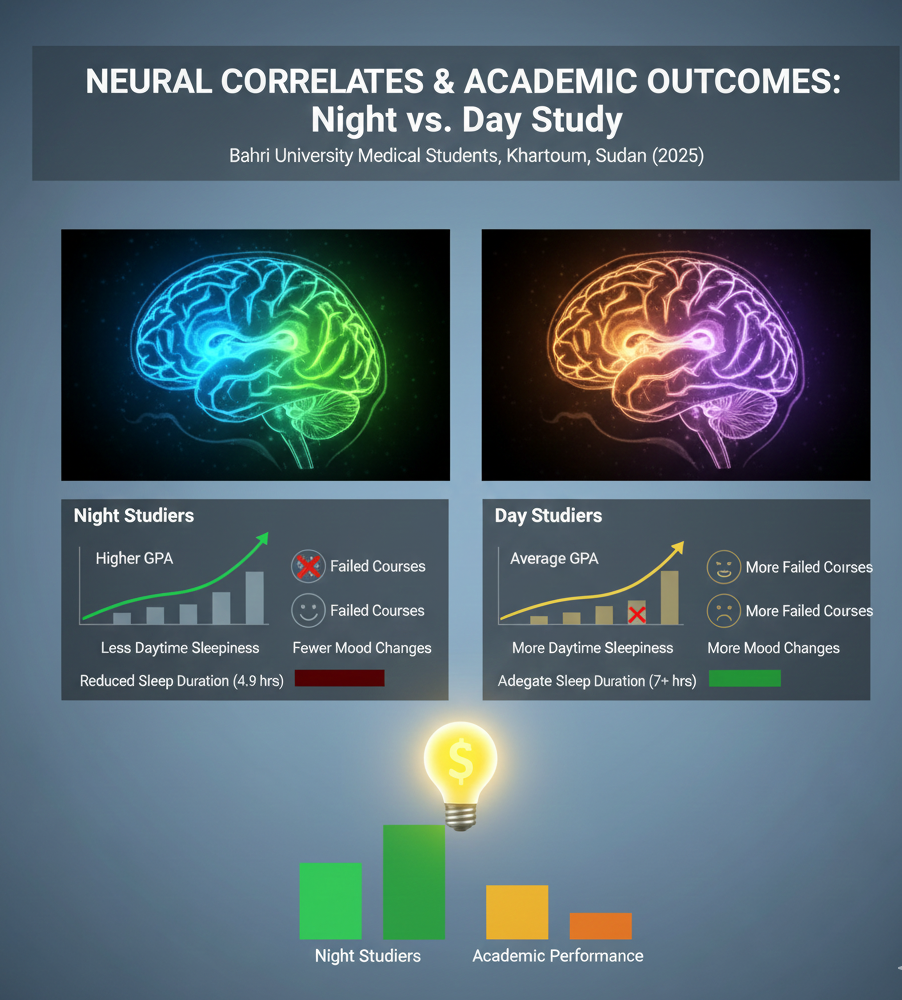
Results: More than half of the students (54.9%) reported primarily studying at night. The overall mean age was 24.3 ± 3.4 years, and most participants were female (54.9%), single (64.8%), and in their fifth year of study (60.6%). Night studiers had a significantly higher mean GPA than non-night studiers (3.3 ± 0.5 vs. 2.9 ± 0.6, p = 0.002) and were more likely to have no failed courses (94.9% vs. 71.9%, p = 0.024). Although academic satisfaction did not differ significantly (p = 0.115), a larger proportion of night studiers were satisfied or very satisfied with their performance (61.5% vs. 40.6%). Night studiers slept an average of 4.9 ± 1.8 hours per night and studied past midnight on 4.2 ± 1.9 nights per week. They reported lower rates of daytime sleepiness (17.9% vs. 84.4%, p < 0.001) and fewer mood changes (59.0% vs. 87.5%, p = 0.008). Stress levels were high overall (50.7% “stressful/very stressful”), with no significant difference between groups (p = 0.064). No significant associations were found between night study and gender, year of study, residence, or marital status (all p > 0.05).
Conclusion: In this sample of final-year medical students, night study was common and was associated with higher GPA and fewer failed courses, despite markedly reduced sleep duration. Night studiers also reported less daytime sleepiness and fewer mood changes, suggesting possible adaptation to nocturnal study patterns. However, given the cross-sectional, self-reported data and small sample size, these findings should be interpreted cautiously. Educational programs should promote balanced study routines that support both academic success and adequate sleep, and future studies with larger samples and objective sleep measures are recommended.
Keywords:
Night study; Medical students; Academic performance; Sleep; Daytime sleepiness; Sudan
Downloads