Echoes in the Data: Phenotyping HFpEF with EHR–Echocardiography Fusion and Machine Learning
Abstract
Abstract
Background: Heart failure with preserved ejection fraction (HFpEF) represents over 50% of all heart failure hospitalizations, yet its clinical heterogeneity hinders targeted therapy. Combining electronic health record (EHR) data with advanced echocardiographic parameters through machine learning may help identify prognostic phenotypes for early intervention.
Objective: To develop and validate a machine-learning model integrating clinical and echocardiographic data for phenotyping HFpEF and predicting one-year readmission or death.
Methods: This multicenter retrospective study included 4,012 adults (mean age 67 ± 10 years; 58% female) with ejection fraction ≥ 50% and NT-proBNP ≥ 125 pg/mL across three tertiary hospitals between 2019 and 2024. A total of 42 variables were extracted, including demographics, laboratory results (creatinine, hemoglobin, HbA1c), comorbidities, medications, and echocardiographic metrics (E/e′ ratio, GLS, LA volume index). Gaussian mixture clustering identified phenotypes, and Cox proportional-hazards models evaluated one-year outcomes.
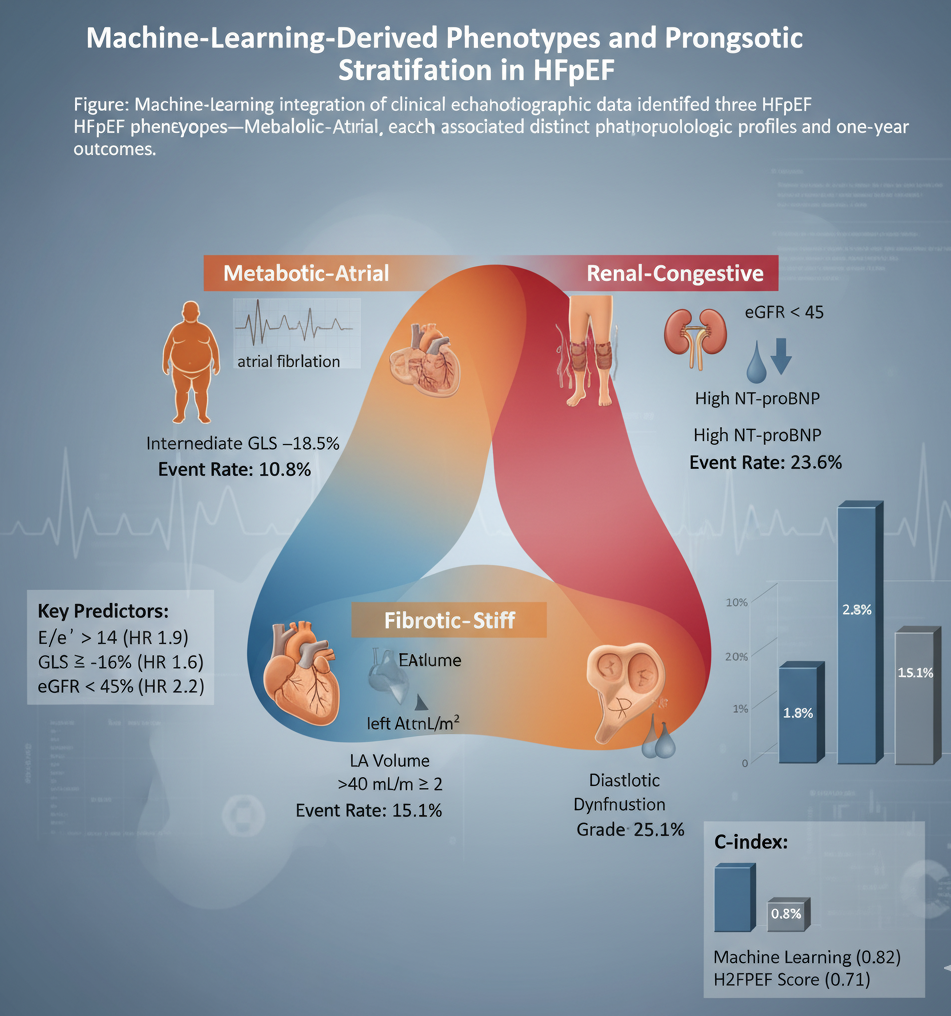
Results: Three distinct phenotypes were identified. Cluster 1 (Metabolic-Atrial) included 34% of the cohort and was characterized by obesity (BMI ≥ 30 kg/m²), frequent atrial fibrillation, and intermediate GLS (–18.5%), with a 12-month event rate of 10.8%. Cluster 2 (Renal-Congestive) represented 28% of patients, marked by eGFR < 45 mL/min and the highest NT-proBNP levels (median 1830 pg/mL), showing a 12-month event rate of 23.6%. Cluster 3 (Fibrotic-Stiff) accounted for 38% of cases, defined by a high left atrial volume index (>40 mL/m²) and diastolic dysfunction grade ≥ 2, with an event rate of 15.1%. The integrated model achieved a C-index of 0.82 (95% CI 0.80–0.84), outperforming the conventional H2FPEF score (0.71). Independent predictors of poor outcome included E/e′ > 14 (HR 1.9, p < 0.001), GLS ≥ –16% (HR 1.6, p = 0.01), and eGFR < 45 (HR 2.2, p = 0.002).
Conclusion: The fusion of EHR and echocardiographic data using machine learning reveals reproducible HFpEF phenotypes with distinct risk patterns. This approach supports personalized prognostication and individualized treatment strategies in cardiometabolic patients.
Downloads