Whispering Pixels: Ultrasound Radiomics for Thyroid Nodule Malignancy in Iodine-Deficient Regions
Keywords:
Thyroid nodule, Radiomics, Ultrasound, Cancer risk, Iodine deficiencyAbstract
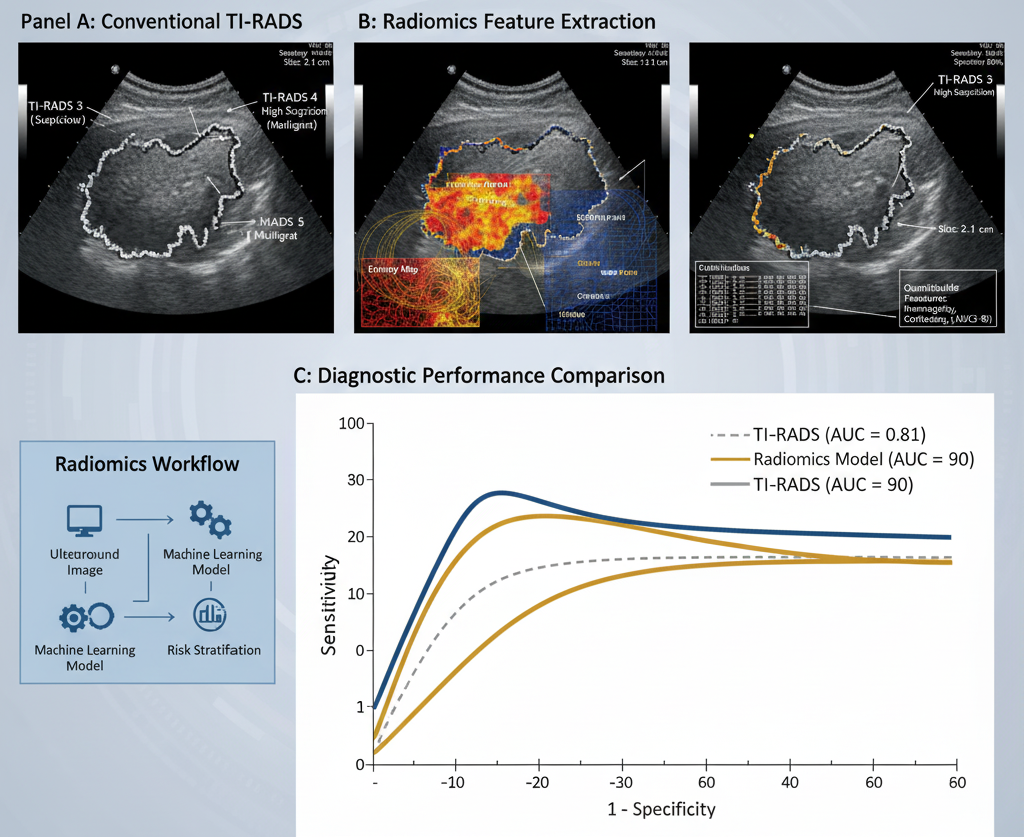
Background: Diagnostic imaging of thyroid nodules in iodine-deficient regions is challenging because benign hyperplastic nodules may mimic malignancy. Conventional TI-RADS scoring has limited sensitivity in such contexts. Radiomics, through advanced quantitative texture analysis, can identify subtle imaging features associated with cancer that are invisible to the human eye.
Objective: To assess the diagnostic performance of an ultrasound radiomics model compared with TI-RADS and evaluate its added value for detecting thyroid malignancy in iodine-deficient populations.
Methods: A prospective observational study was conducted between 2022 and 2024 at three hospitals located in known iodine-deficient areas. A total of 1,028 nodules in 876 consecutive patients (mean age 47 ± 11 years, 72% female) were analyzed. Each patient underwent high-resolution ultrasound imaging followed by histopathological confirmation. Radiomic features, including first-order statistics, texture, and wavelet-based parameters, were extracted and processed using a LASSO-based selection method. Logistic regression and random-forest models were trained and validated with 10-fold cross-validation.
Results: Malignancy was confirmed in 22.9% of nodules. The conventional TI-RADS achieved an area under the curve (AUC) of 0.81, whereas the radiomics model reached 0.90. When combined with TI-RADS scores, the integrated model achieved an AUC of 0.93 (95% CI 0.91–0.95), sensitivity 88%, and specificity 85%. The most important predictors were high gray-level entropy (odds ratio 2.7) and irregular margin compactness (odds ratio 2.1). The combined model improved net reclassification by 18% compared to TI-RADS alone.
Conclusion: Ultrasound radiomics substantially enhances the accuracy of thyroid cancer risk prediction in iodine-deficient areas. Integrating radiomics with existing scoring systems may improve early diagnosis and reduce unnecessary biopsies.
Downloads